
Agentic commerce
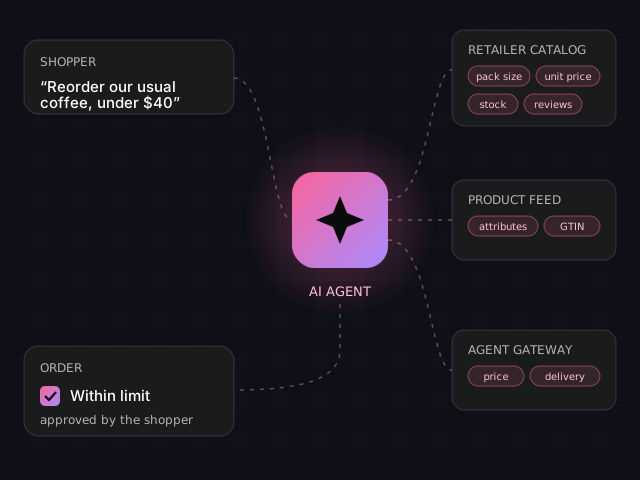
Agentic commerce is shopping where an AI agent does the legwork for a person: it searches, compares products and prices, and can place the order, usually within limits the shopper sets. The shopper says what they want (“reorder our usual coffee, under $40”) and the agent handles the steps a person would normally click through.
Why it matters for CPG brands
When an agent does the comparing, it reads structured catalog data such as attributes, pack size, price, availability and reviews, not your lifestyle photos. Retailers are also choosing sides. On October 21, 2026, Walmart announced Agent Profiles, an MCP-based Walmart Agent Gateway starting as a beta, and terms for AI agents, and said agents see the same prices a person sees on Walmart.com. Amazon blocked Meta's Muse agent in September 2026 and keeps its own assistant, Alexa for Shopping, as the agent inside its store. A brand has to be readable by outside agents on open retailers and by Amazon's assistant on Amazon.
How an AI agent picks a product
Pick a step to see what the agent reads and what your brand can control. This is a simplified model built from how Walmart, Google and OpenAI describe their agent shopping flows; individual agents differ.
01 Brief: The shopper sets the goal and the limits.
“Reorder our usual coffee, under $40.” The agent notes the budget, the brand or product the shopper means, and any rules, like needing approval first.
The request, past orders it's allowed to see, and spending limits. Walmart's Agent Profiles let shoppers cap spend and require approval by default.[1]
Product names that match how people ask: flavor, size, pack count and form, in plain words.
02 Find: It pulls candidates from retailer catalogs.
The agent searches the retailers it can reach, through gateways and protocols such as Walmart's Agent Gateway, Google's UCP or merchant feeds in ChatGPT.
03 Filter: It drops anything that breaks a rule.
Wrong size, over budget, out of stock, can't deliver in time, missing a required claim like “gluten-free.” These are yes/no checks.
Structured fields: pack size, unit count, price, stock, delivery window, dietary and ingredient attributes.[6]
Complete, accurate attributes and in-stock listings. A blank field can't pass a filter.
04 Compare: It ranks what's left.
Among items that pass, the agent weighs price per unit, ratings and reviews, delivery speed and how well each one fits the request.
Prices, reviews, ratings, Q&A and specs. OpenAI says ChatGPT's shopping results are organic and ranked by relevance, not ads.[10]
Competitive unit pricing, review volume and answers to common questions in the listing itself.
05 Check: It confirms price and permission.
Before buying, the agent re-checks the final price, fees and stock, and asks the shopper if the purchase needs approval.
Final price with offers and fees. Walmart says agents see the same prices a person sees on Walmart.com.[1]
Accurate pricing and fees everywhere. A surprise at checkout can end the order.
06 Buy: It places the order and remembers it.
The order goes through the retailer, which stays the seller of record. Next time, the same product may become the agent's default.
Order confirmation, delivery updates and the shopper's history for next time.[8]
Reliable stock and fulfillment, so the reorder keeps choosing you.
How agentic commerce got here
Key launches, protocols and fights from Rufus in 2024 to Walmart’s Agent Gateway in October 2026. Filter by type.
Showing 11 of 11 milestones
- Retailers
Amazon launches Rufus in beta
Amazon's generative AI shopping assistant starts answering product questions inside the Amazon Shopping app, using the catalog, reviews and community Q&A.[11]
- AI platforms
Perplexity adds “Buy with Pro”
US Perplexity Pro subscribers can check out on select products without leaving the answer. Perplexity also opens a Merchant Program for product data.[12]
- Retailers
Walmart partners with OpenAI
Walmart announces Instant Checkout for its products inside ChatGPT.[15]
- AI platforms
ChatGPT shifts from Instant Checkout to discovery
OpenAI lets merchants use their own checkout and focuses on finding and comparing products from merchant feeds. Walmart launches an in-ChatGPT app with account linking and loyalty.[9]
- Disputes
Appeals court lifts the injunction against Perplexity
The Ninth Circuit vacates the preliminary injunction a lower court had granted Amazon in the Comet case.[19]
AI shoppers are already showing up, and buying
Adobe Analytics measures visits to US retail sites that come from AI assistants such as ChatGPT, Gemini and Perplexity. Switch views, then hover, tap or tab through the bars for details.
AI-referred visits now convert better than other traffic
Conversion rate of visits from AI assistants to US retail sites, relative to non-AI visits (Adobe Analytics). Below zero means worse, above zero means better.
Non-AI traffic includes channels such as paid search and email. Adobe says July 2026 was the 11th straight month AI traffic converted better. Sources: Adobe[6] · Digital Commerce 360[21] · Digital Commerce 360[22] · Adobe[4]
AI traffic to US retail sites keeps growing year over year
Year-over-year growth in visits referred by AI assistants, as Adobe reported each period. Periods differ in length, so compare them with care.
Holiday 2026 (Nov–Dec) is Adobe's forecast, not a measurement, so it's striped. Growth rates fall as the base gets bigger: Adobe puts total growth since October 2024 at 1,219% as of July 2026. Sources: Adobe[23] · Digital Commerce 360[21] · Adobe[6] · Digital Commerce 360[22] · Digital Commerce 360[5] · Business Wire[24]
Shoppers who arrive from AI stay longer and buy more
Visits referred by AI assistants compared with other visits to US retail sites, July 2026 (Adobe Analytics).
Bounce rate is lower for AI-referred visits, which is good, so it's drawn in purple below the line. Sources: Digital Commerce 360[5]
View the data as a table
Can AI read the page? Grocery scores lowest
Share of homepage content that large language models can read, by retail category, July 2026 (Adobe). CPG-heavy categories are highlighted.
Adobe also found product pages were the least readable page type in April 2026, at 66%.[6] Category scores: Digital Commerce 360[5]
Shopping agents and marketplace policies, compared
Where outside AI agents can shop, how they connect and what data they read, as of October 2026.
| Player | Outside agents | How agents connect | What the agent reads | Checkout |
|---|---|---|---|---|
| Walmart | Open, with controls | Walmart Agent Gateway (MCP, beta) and Agent Profiles; Walmart apps inside ChatGPT and Gemini | Walmart catalog, prices, availability and the shopper's “usuals” | On Walmart. Shoppers set spending limits; approval is on by default[1][9] |
| Amazon | Own agent only | Outside agents are blocked (Meta's Muse, Sept. 2026); Amazon sued Perplexity over Comet | Its own Alexa for Shopping / Rufus reads the Amazon catalog, reviews and community Q&A | Inside Amazon, including auto-buy and price alerts[2][3][16] |
| ChatGPT (OpenAI) | Discovery first | Merchant product feeds; the open Agentic Commerce Protocol; retailer apps in ChatGPT | Structured product data and promotions from merchant feeds, plus the web | Since Mar. 2026, mostly on the merchant's own checkout or app[9][13][10] |
| Google AI Mode & Gemini | Open protocol | Universal Commerce Protocol (UCP), compatible with A2A, AP2 and MCP | Merchant Center product data | Agentic checkout on Google for eligible US merchants; retailer is seller of record[8][18] |
| Perplexity | Agent + checkout | Buy with Pro, the Merchant Program and the Comet browser agent | Merchant product specs and the open web | One-click checkout on select products for US Pro users[12][19] |
| Meta Muse + Shopify | Agent + checkout | Shop Pay checkout for Muse across Shopify stores (Sept. 2026) | Shopify store catalogs | Shop Pay; blocked on Amazon[20][2] |
Open outside agents can connect · Discovery first finds products, checkout mostly elsewhere · Own agent only outside agents blocked. Policies change fast; check the linked sources.
What CPG brands should fix first
Tick items off as you go. Your progress is saved in this browser only.
0 of 7 done
Example
A household asks its assistant to restock paper towels and oat milk. Through Walmart's gateway the agent looks for the shopper's usuals, such as “a particular brand of milk” in Walmart's own example, and checks the order against a spending limit the shopper set. The oat milk brand with complete attributes, consistent pack sizes and in-stock listings is the one the agent can match and reorder.
Read more
- Walmart Opened the Door to AI Shopping Agents. Amazon Locked It. What Should CPG Brands Do Now?
- Rufus Is Now Alexa for Shopping: How to Optimize Amazon Listings for Amazon's AI Assistant
- The AI-Ready Product Listing Checklist: 30 Checks for Titles, Attributes, Images, Schema and Feeds
Related XENA products
- XENA 360: Unified marketplace sales, ads and operations
- SearchPanel: SKU-level AI visibility tracking and fixes
Frequently asked questions
Is agentic commerce the same as AI shopping assistants?
They overlap. A shopping assistant answers questions and suggests products; agentic commerce is when the agent also acts, such as building the cart or checking out, within limits the shopper approves.
Can AI agents buy on Amazon?
Not outside ones, for now. Amazon blocked Meta's Muse agent in September 2026. Inside Amazon, its own Alexa for Shopping assistant plays that role.
What should a CPG brand fix first?
Make product data complete and consistent across every retailer: attributes, pack size, price and stock. Agents compare those fields directly, so gaps make a product harder to pick.
Related terms
Sources
- Walmart: Walmart Makes It Possible for Agents to Shop on Behalf of Customers (Oct. 21, 2026)
- GeekWire: Amazon blocks Meta's Muse AI assistant in new standoff over agentic shopping (Sept. 2026)
- About Amazon: Alexa for Shopping
- Adobe: AI Traffic Trends Report, Aug. 19, 2026 (PDF)
- Digital Commerce 360: Adobe: AI-referral traffic spending, converting more than counterparts (Aug. 19, 2026)
- Adobe: AI traffic surges to retail sites, but many aren't machine-readable (Apr. 2026)
- Axios: AI shopping wars: Walmart welcomes AI agents while Amazon blocks Muse (Oct. 21, 2026)
- Google: New agentic commerce tools and the Universal Commerce Protocol (Jan. 11, 2026)
- CNBC: OpenAI revamps shopping experience in ChatGPT after struggling with Instant Checkout (Mar. 24, 2026)
- OpenAI Help Center: Improved shopping results from ChatGPT search
- About Amazon: ‘Amazon Rufus’ AI experience comes to the Amazon Shopping app (Feb. 1, 2024)
- Perplexity: Shop like a Pro (Nov. 18, 2024)
- OpenAI: Buy it in ChatGPT: Instant Checkout and the Agentic Commerce Protocol (Sept. 29, 2025)
- Stripe: Developing an open standard for agentic commerce (Sept. 29, 2025)
- Walmart: Walmart partners with OpenAI to create AI-first shopping experiences (Oct. 14, 2025)
- Reuters: Perplexity receives legal threat from Amazon over agentic AI shopping tool (Nov. 4, 2025)
- CourtListener: Amazon v. Perplexity AI, case docket
- Google Merchant Center Help: Agentic checkout on Google
- Justia: Ninth Circuit opinion, No. 26-1444 (Aug. 4, 2026)
- The New Stack: Amazon blocks Meta's Muse; Shopify and Meta add Shop Pay checkout (Sept. 2026)
- Digital Commerce 360: Adobe generative AI-powered shopping data, July 2025 (Aug. 21, 2025)
- Digital Commerce 360: Adobe: AI-referred traffic to retail sites doubles in a year (June 17, 2026)
- Adobe: Generative AI-powered shopping rises with traffic to US retail sites (Mar. 2025)
- Business Wire: Adobe forecasts US holiday shopping season to hit $275.1 billion online (Sept. 28, 2026)
Third-party facts and figures are from the linked pages, checked Oct 29, 2026. Chart values are as reported by Adobe for each period; the Holiday 2026 figure is a forecast. The diagram and illustration are simplified models by XENA Intelligence. Examples are illustrative unless they link to a published XENA case study.